Roughly 77 percent of professionals say they have experienced burnout at their current job, according to a Deloitte workplace burnout survey. That number is not a blip. It is a signal that something structural has gone wrong in how organizations are asking people to work.
The frustrating part is that most responses to burnout are cosmetic. A wellness app here, a mental health day there. Teams get a temporary reprieve, but nothing actually changes. Within weeks, the pressure rebuilds, the exhaustion returns, and leaders are left wondering why the interventions are not sticking.
Bringing in a burnout keynote speaker is one of the most effective tools available to organizations that want to move past surface treatment and address what is actually driving the problem. But only if you know what to look for, what to expect, and how to use that investment well.
Why Burnout Is Not a Personal Failure
One of the most damaging myths in organizational culture is the idea that burnout is a weakness. That the people burning out simply could not handle the pressure. That narrative protects systems at the expense of people, and it tends to thrive in high-performance environments where admitting struggle feels professionally dangerous.
The World Health Organization classifies burnout as an occupational phenomenon, not a personal one. It is defined by three dimensions: emotional exhaustion, increasing mental distance from one’s work, and reduced professional effectiveness. None of those are character flaws. They are predictable outcomes of sustained pressure without adequate support, autonomy, or meaning.
When an organization frames burnout as a personal problem, it creates a culture where people hide their depletion until they hit a wall. High performers are especially vulnerable here because they have spent years training themselves to push through discomfort, and they often do not recognize the warning signs until the damage is already done.
This is exactly where skilled keynote work makes a difference. A great speaker does not just inform an audience, they shift the frame. They give people permission to see their experience differently and, critically, they give leaders a new language for the conversation.
What a Burnout Keynote Speaker Actually Does
The word “motivational” gets used loosely in the events industry, and it has muddied expectations around what a keynote speaker is actually capable of delivering. Motivation fades. A well-constructed keynote on burnout should do something more durable.
The best speakers in this space combine personal credibility with a transferable framework. They are not just telling a compelling story. They are giving the audience a model they can apply the following Monday morning.
Here is what that looks like in practice:
- Reframing burnout as a system signal, not an individual failure. When people understand that their exhaustion is partly a response to structural conditions, the shame lifts. That shift alone can reduce the isolation high-performers feel when they are struggling.
- Teaching leaders to identify burnout in others before it becomes a retention crisis. Disengagement rarely announces itself. It builds quietly through missed energy, shrinking contribution, and a gradual withdrawal from connection. Effective keynote content trains leaders to see those early signs.
- Introducing a framework for inner capacity. The missing layer in most burnout conversations is the interior one. Resilience is not just about managing time or workload. It is about what a person is carrying internally and whether they have the tools to carry it differently.
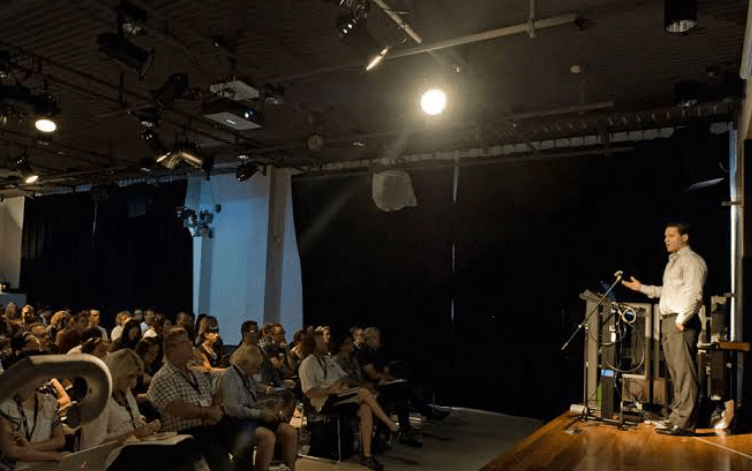
- Creating psychological safety in large group settings. A skilled speaker can surface difficult conversations in a way that feels safe for an auditorium of 500 people, something a training module or handbook rarely achieves.
Caleb Campbell, a former West Point graduate and NFL linebacker turned executive coach and speaker, built his entire methodology around this interior dimension. His Inner Advantage framework grew directly from a personal burnout crisis that took him from professional football to working as a janitor in Canada in exchange for access to therapy. That trajectory gives his work a credibility that purely academic approaches often lack.
The Difference Between a Good Speaker and the Right One
Not every speaker is right for every room. This matters more in the burnout space than almost anywhere else, because the topic requires a specific kind of trust between speaker and audience.
A few things to look for when evaluating whether a burnout keynote speaker is the right fit for your organization:
1. Do they have lived experience, not just research? Data and frameworks are useful. But in a room full of exhausted, skeptical professionals, what moves people is a speaker who has genuinely been through it. Audiences can feel the difference between someone who has studied burnout and someone who has lived it.
2. Do they have credibility in high-performance environments? If your organization is driven by results and achievement, a speaker whose background is exclusively therapeutic may not land. The audience needs to believe the speaker understands pressure at a serious level before they will take the recovery message seriously.
3. Do they offer something actionable, not just emotional? A talk that leaves people feeling inspired but gives them nothing concrete to do is a missed opportunity. Look for speakers who deliver a named framework, a set of questions, or a process the audience can take back to their work.
4. Can their content be customized to your industry and workforce? The burnout experience in a healthcare system looks different from burnout in a tech startup or a financial services firm. A speaker who can adapt their material to your specific context will have significantly more impact than one delivering a fixed set speech.
Organizations like US Bank, Cisco, Google, LinkedIn, and USAA have all invested in keynote programming that addresses the human side of performance. The pattern across those organizations is clear: when leaders model a different relationship with pressure, the culture begins to shift.
How to Maximize the Return on a Keynote Investment
Bringing in a speaker is a starting point, not a destination. The organizations that see lasting change from keynote programming treat the event as a catalyst rather than a solution.
A few practical steps that extend the impact:
- Brief your speaker thoroughly. Share recent engagement data, leadership challenges, and any specific language your team uses around performance and pressure. The more context a speaker has, the more precisely they can target their message.
- Build in reflection time after the keynote. A structured 20-minute team conversation immediately following the talk dramatically increases retention and application. Give people a prompt, not just a coffee break.
- Connect the content to existing leadership development work. If your organization already has a coaching culture or a leadership framework, ask the speaker how their material integrates with it. Standalone events lose impact when they feel disconnected from everything else.
- Follow up within 30 days. Whether through a facilitated workshop, a coaching engagement, or even a short written resource, following up within a month keeps the momentum alive. Content that sits without reinforcement fades quickly.
If you are in the early stages of evaluating options, reading about what to expect from a burnout keynote speaker before making a decision will help you ask sharper questions during the selection process and set clearer expectations with stakeholders.
What Burnout Prevention Actually Requires at the Leadership Level
Keynote speakers can shift awareness and introduce frameworks. But the longer-term work of burnout prevention lives inside the culture, and that starts with how leaders are operating.
Burnout tends to travel downward in organizations. When senior leaders are running on empty and treating their own exhaustion as a badge of honor, the teams beneath them absorb that standard. Consciously or not, people calibrate to the ceiling they see above them.
Prevention requires leaders who are willing to model a different relationship with their own limits. That does not mean doing less. It means doing the inner work that allows someone to carry significant pressure without it hollowing them out.
This is the core of what makes coaching a natural companion to keynote work. A keynote can reach 500 people in an afternoon. Coaching takes that message deeper for the individuals whose decisions shape the culture for everyone else.
Key Takeaways
- Burnout is an occupational phenomenon with systemic causes, not a personal failure or character weakness.
- A burnout keynote speaker is most effective when they bring lived experience, a transferable framework, and the ability to shift the cultural narrative around pressure.
- The speaker’s background matters. High-performance credibility increases trust in a results-oriented organizational culture.
- The return on a keynote investment depends heavily on how the organization follows up. Reflection time, coaching connections, and reinforcement within 30 days all extend impact.
- Burnout prevention at scale requires leaders who model a different relationship with their own capacity, not just policies or programs.
Frequently Asked Questions
What topics does a burnout keynote speaker typically cover? Most burnout keynote speakers address the causes and signs of burnout, the psychological and organizational factors that drive it, and frameworks for building sustainable performance. The best speakers also address leadership responsibility, team culture, and the inner work required to prevent recurrence rather than just recovery.
How long is a typical burnout keynote? Most keynote formats run between 45 and 90 minutes, with some speakers offering shorter 30-minute versions for conference slots. The more impactful engagements tend to include time for Q and A or a brief facilitated discussion, which helps the audience connect the content to their specific context.
Is a burnout keynote only useful for teams already experiencing burnout? Not at all. Prevention is actually where keynote programming delivers the strongest return. Bringing in a speaker before burnout becomes a retention or performance crisis gives leaders the language and framework to catch warning signs early and respond differently.
How do I know if a burnout keynote speaker is credible? Look at their client history, the specificity of their framework, and whether they have personal experience with the subject matter. Speakers who have navigated burnout themselves, particularly in high-performance contexts, tend to connect more authentically with professional audiences who are skeptical of generic wellness messaging.
Can a keynote speaker help with team disengagement, not just individual burnout? Yes, and this is often where the work is most needed. Individual burnout and collective disengagement are connected. A keynote that reframes the relationship between performance and inner capacity can shift both, especially when the content is followed by structured team conversation.
See also: A Practical Guide for Stress-Free Relocation in Australia
Conclusion
Burnout does not fix itself, and the organizations waiting for it to pass are often the ones that end up losing their best people. The path forward requires naming the problem clearly, changing the cultural narrative around performance and pressure, and giving leaders the tools to operate differently.
A great burnout keynote speaker does not just fill an event slot. They open a door that most people in an organization have been quietly standing in front of for a long time. What matters is what happens after the door opens.
If the topic resonates and you want to explore what this kind of work looks like in practice, Caleb Campbell offers both keynote programming and executive coaching for organizations ready to move past awareness and into something that actually lasts.